※本ページはプロモーションが含まれます
Disclosure: This post contains affiliate links. If you buy through them, we may earn a commission at no additional cost to you. Learn more.
If you’re deciding between a booster box and a starter deck, here’s the short version: starter decks are the better dollar-for-dollar buy if you want to actually play a legal deck fast, while booster boxes only pay off if your goal is chasing specific chase rares or building a deck around a Leader that isn’t sold as a starter. Most players end up needing both eventually — they just don’t need both on day one.
That distinction matters more in this game than in a lot of other TCGs, because One Piece Card Game’s starter decks are unusually complete. Unlike, say, a Pokémon theme deck that’s intentionally weaker than what you’d build from packs, an OPCG starter deck ships as a genuinely tournament-legal 51-card list (50-card deck + Leader) with playable synergy out of the box. That changes the math on which product is actually “worth it” depending on what you’re trying to do.
- What You Actually Get in a Starter Deck
- What You Actually Get in a Booster Box
- If Your Goal Is Competitive Play
- If Your Goal Is Collecting
- If Your Goal Is Casual Play
- Comparison Table: Booster Box vs. Starter Deck
- Frequently Asked Questions
- Is it cheaper to build a competitive deck from a booster box or by buying singles after a starter deck?
- Do starter decks ever get reprinted, or do they go out of stock permanently?
- Can I mix cards from a Japanese booster box into an English-language competitive deck?
- Is a booster box a good investment, or should I only buy it to play?
- What’s the safest way to buy real Japanese-print product from overseas?
- The Takeaway
- Related Articles
- More Trading Card Game Guides
What You Actually Get in a Starter Deck
Every starter deck (ST-XX numbering) contains a pre-built 50-card main deck, 1 Leader card, and 10 DON!! cards — everything needed to sit down and play a legal game immediately. Most retail for roughly ¥1,700-¥5,600 (about $11-$37 depending on the specific deck and whether it bundles a bonus booster pack), which is a fraction of what you’d spend chasing the same card pool through packs.
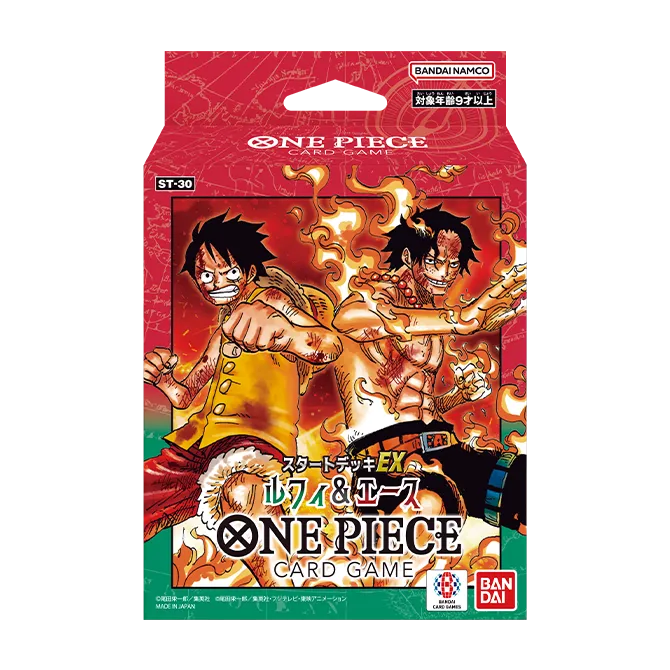
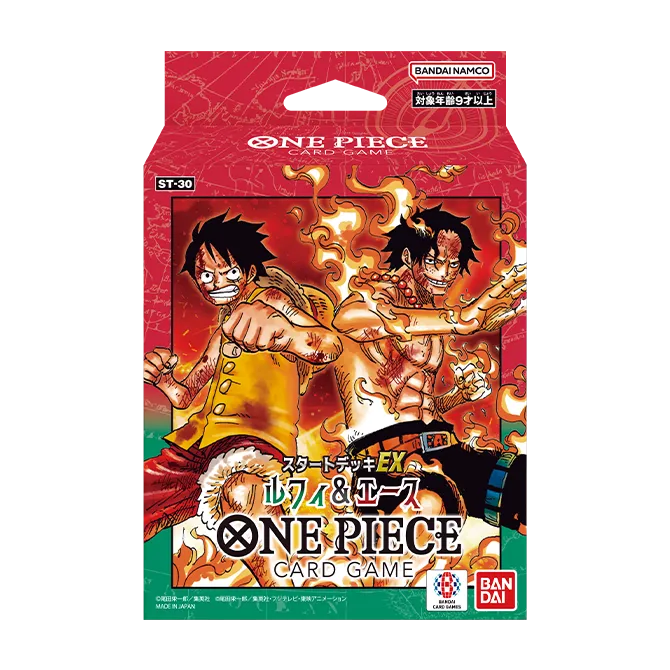
The newer Starter Deck EX -Luffy & Ace- (ST-30) is a good example of where Bandai has taken the format. It’s a Red/Green dual-color deck built around the Paramount War arc, and as an “EX” tier starter it carries a bit more premium content and a higher power ceiling than a standard-tier deck — it released in Japan April 11, 2026 and in English June 12, 2026. The tradeoff: EX decks cost noticeably more than the ~$12 entry-level starters (this one runs closer to $35-$36), and a dual-color deck asks a little more of a first-time player than a simple mono-color ramp deck does.
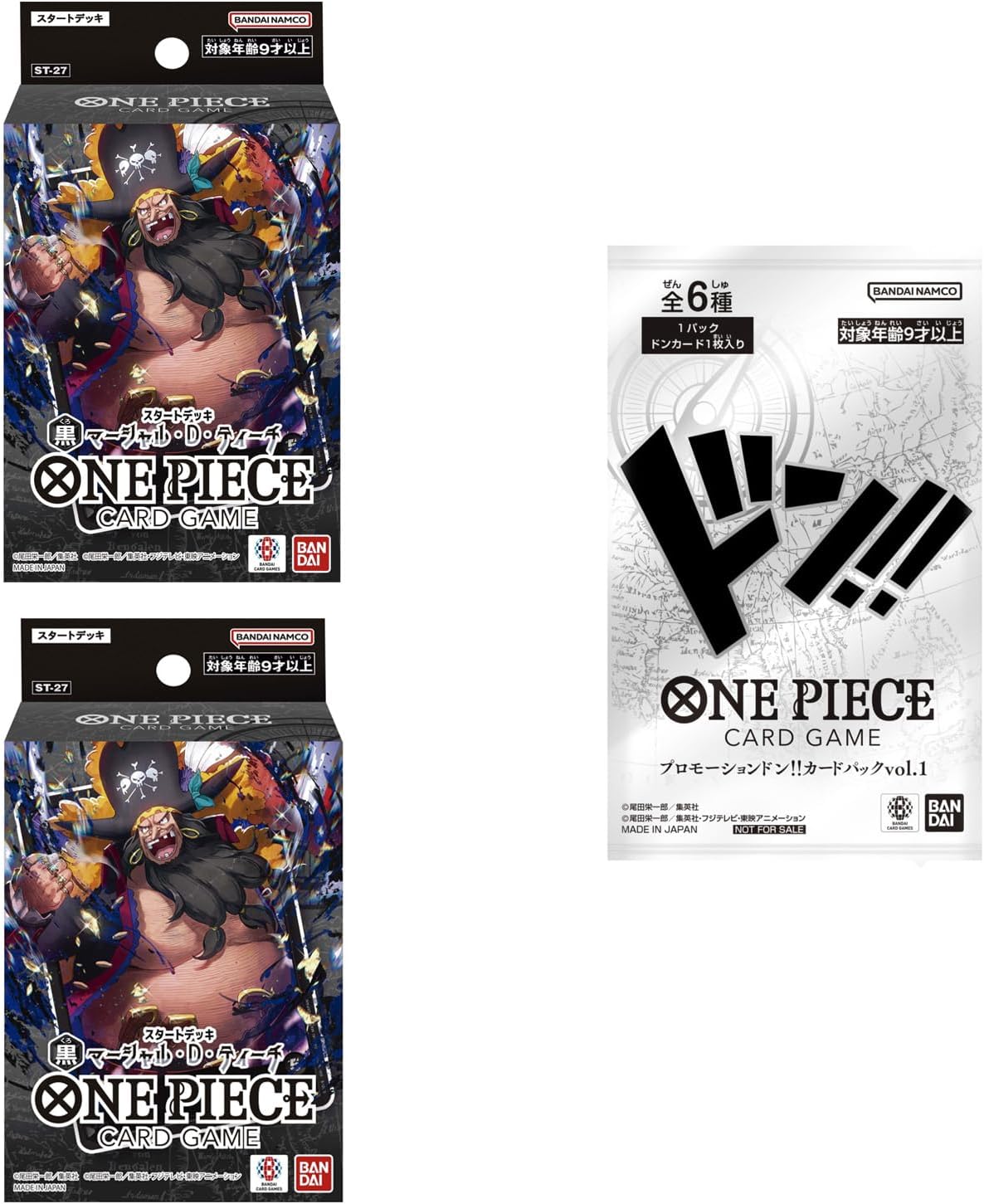
For a cheaper, more focused option, Starter Deck -Marshall D. Teach- (ST-27) is a mono-black deck built around discard-and-drain synergy, and this particular listing bundles in a bonus promo pack. The catch with any single-color starter: it’s the least flexible option if you later want to splash a second color, since you’d effectively be starting a new deck rather than upgrading this one.
The bigger structural downside of starter decks generally: they’re static. What’s printed in the box is what you get — no chase rares, no alternate arts, no gambling for value. If your goal is collecting or flipping cards, a starter deck by itself won’t get you there.
What You Actually Get in a Booster Box
A standard booster box contains 24 packs of 6 cards each (144 cards total), randomized across that set’s full rarity spread — Common through Secret Rare, plus parallel foils and alt-art “Manga Rare” chase cards. This is where the game’s real collector economy lives.
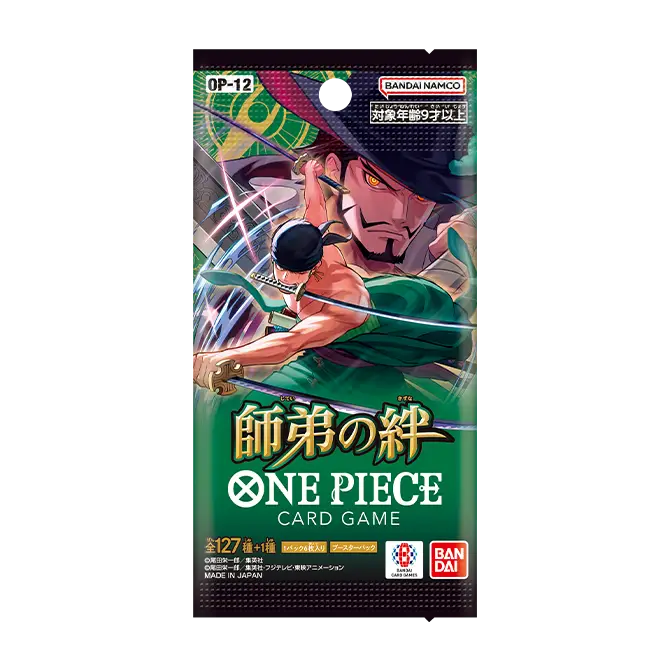
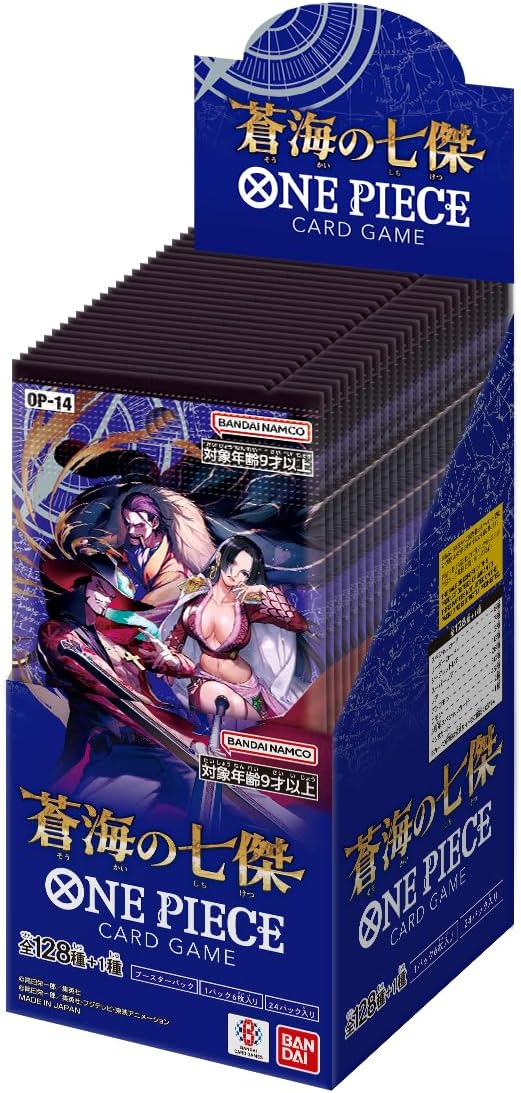
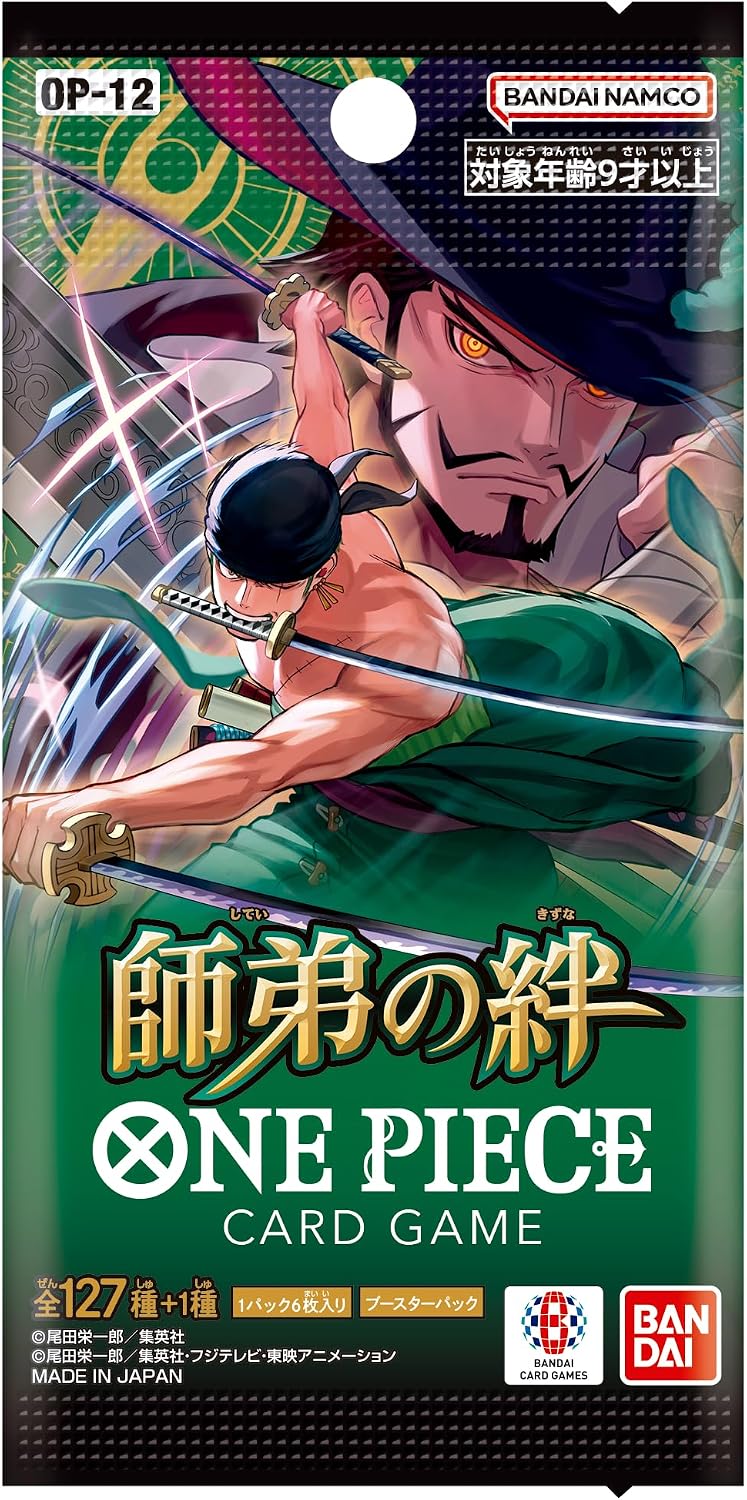
OP-12: Bond Between Master and Disciple booster box (released Japan December 2024) runs about ¥13,392 (~$89) at current Discovery Japan Mall pricing, and OP-14: The Seven Heroes of the Blue Sea booster box (Japan November 2025) runs closer to ¥12,127 (~$81) — both are still comfortably in-stock at this mall as of this writing, even though the competitive format has moved past them (OP-15 released April 2026, OP-16 released June 12, 2026, and OP-17 “The World’s Strongest Warriors” is the game’s 4th-anniversary set, releasing in Japan August 22, 2026 and worldwide in English on August 28, 2026, at an official ¥5,760/box or roughly $120 MSRP for English). That OP-17 box isn’t stocked at this particular import mall yet since it’s brand new — expect that to change once initial Japanese supply settles.

The real caveat with booster boxes: a box does not guarantee you a complete, optimized deck. You’re not pulling one copy of every card in the set — pulls are random by design, Leaders are just another pull (not one-per-pack), and older sets that are now scarce can get genuinely expensive on the secondary market purely from short print runs. OP-11: Godspeed Fist booster box (Japan release March 2025) is a good cautionary example — it’s now priced around ¥30,975 (~$207) at this mall, more than double what OP-12 or OP-14 cost, almost entirely because supply dried up rather than because it’s still the competitive best set to open. Don’t buy an older box assuming you’ll definitely pull a specific card; you might open a full box and still not get the SEC you wanted.

If Your Goal Is Competitive Play
Buy a starter deck first, then add singles for the specific upgrades your local meta calls for. A booster box is an inefficient way to build a competitive 50-card deck because you’ll open a lot of off-color and duplicate commons you can’t use, alongside the cards you actually need. Community box-break tracking around the OP-16 release window (June 2026) put SEC pull rates at roughly 1 in 8-12 packs — meaning you could open an entire box and still miss the exact chase card your decklist wants, while a $15 single of that same card off the secondary market gets you there directly and immediately. The one exception: if a brand-new Leader you want simply isn’t available as a starter deck yet (which is common in the weeks right after a numbered set drops), a box is currently the only way in.
If Your Goal Is Collecting
Booster boxes win here, no contest — that’s where the Secret Rares, Manga Rare (Super Parallel) alt arts, and set-exclusive foils actually live. OP-17 is a good marker of where this is headed: it introduces a new “Treasure Rare” tier that sits above Secret Rare, plus Manga Rare treatments for all four original Emperors (Whitebeard, Shanks, Kaido, and Big Mom) — the kind of chase content that drives real market activity. If you’d rather not gamble on random pulls at all, ONE PIECE CARD THE BEST Vol.2 (PRB-02) is a curated premium booster of reprinted staples with a sparkle/parallel card guaranteed in every pack — a lower-variance way to build out a collection, though it typically skips brand-new Leaders, so it supplements rather than replaces a box or starter deck.
 Standard caveat for any of this: sealed box and chase-card prices move constantly with the meta and hype cycle, so treat any price mentioned here as a snapshot as of August 2026, not a guarantee — this isn’t financial advice, and speculating on cardboard the way you’d speculate on an asset is a genuinely risky habit.
If Your Goal Is Casual Play
This is where starter decks are almost unambiguously the right call. Two starter decks (roughly $20-$40 total depending on which ones) give you two fully legal, thematically distinct decks you can hand to a friend and play head-to-head that same evening — no deckbuilding knowledge, no pack-opening gamble, no waiting to see what you pulled. A single box, by contrast, gives you a pile of loose cards you then have to sort and build with, which is a worse first-session experience for a casual or family game night.
Comparison Table: Booster Box vs. Starter Deck
| Product | Type | Approx. Price (Aug 2026)* | Best For | Key Downside |
|---|---|---|---|---|
| ST-27 Marshall D. Teach | Starter Deck | ~$21 | Cheap, focused mono-color deck | Least flexible if you want a 2nd color later |
| ST-30 Luffy & Ace (EX) | Starter Deck (EX tier) | ~$36 | Higher-power starter with newer synergy | Costs 2-3x a base starter deck |
| ONE PIECE CARD THE BEST Vol.2 (PRB-02) | Premium Booster (reprints) | ~$57/box | Guaranteed sparkle cards, zero variance risk | Rarely includes a new Leader |
| OP-14 The Seven Heroes of the Blue Sea | Standard Booster Box | ~$81/box | Chase rares, building a real deck around a full color pair | Random Leader/rare pulls, no guarantee |
| OP-12 Bond Between Master and Disciple | Standard Booster Box | ~$89/box | Same as above, slightly older set | Rotating further out of top competitive tier |
| OP-11 Godspeed Fist | Standard Booster Box | ~$207/box | Illustrates scarcity risk on older sets | Price inflated by low remaining supply, not current meta strength |
*Converted at roughly ¥150/$1 from Discovery Japan Mall’s JPY listings; live prices and stock fluctuate, so check the linked listing for the current figure. Card and sealed-product prices move constantly — this isn’t financial advice, just a snapshot as of this writing.
Frequently Asked Questions
Is it cheaper to build a competitive deck from a booster box or by buying singles after a starter deck?
Almost always the starter-deck-plus-singles route. A box costs $80-$90+ and gives you a random spread of cards, many of which you’ll never use in a single deck. Buying a $12-$37 starter deck and then adding 4-8 targeted singles (commonly $2-$20 each depending on rarity) to round out the build is typically cheaper and gets you to a tournament-legal list faster, unless the specific Leader you want is genuinely not sold as a starter deck yet.
Do starter decks ever get reprinted, or do they go out of stock permanently?
Some do sell out and become collector items in their own right (early decks like ST-8 and ST-9 are now scarcer than when they released), but Bandai has continued releasing new starter deck waves alongside almost every numbered set, so there’s rarely a long gap where no current, in-print starter deck is available. If a specific older deck is sold out, check whether a newer deck covers a similar color pair or playstyle before paying a scalped price for the original.
Can I mix cards from a Japanese booster box into an English-language competitive deck?
Functionally, card text is identical regardless of print language — but tournament legality by language is region-specific. English cards became usable alongside Japanese ones in Taiwan and Thailand starting November 2025, and French cards became legal in Europe from February 2025, but that doesn’t mean every region allows mixed-language decks. Check your specific region’s current floor rules before building a Regional-legal deck around imported Japanese singles.
Is a booster box a good investment, or should I only buy it to play?
Treat sealed product as a hobby purchase, not an investment plan. Prices on older boxes (like the OP-11 example above) can rise once print runs dry up, but that’s driven by scarcity and speculation, not a guarantee — plenty of sealed product simply sits flat or drops once a set’s hype cycle ends and newer sets take the competitive spotlight. If you’re buying to open and play, that’s a much safer motivation than buying sealed boxes purely hoping to resell them later.
What’s the safest way to buy real Japanese-print product from overseas?
Stick to established importers or malls that list verifiable BANDAI product listings (set codes, official box art, stated pack/card counts) rather than unbranded “mystery box” listings on general marketplaces, which carry real counterfeit risk for loose singles in particular. Sealed product from a mall with clear stock and category listings, like the products linked in this article, is generally lower-risk than buying loose singles of high-value chase cards from an unverified seller.
The Takeaway
There’s no single “better” product — it depends entirely on what you’re optimizing for. Starter decks are the value play for anyone who wants to actually play the game today without gambling on packs; booster boxes are the right tool specifically for chasing collector-grade rares or building around a brand-new Leader that hasn’t hit starter-deck format yet. If you’re brand new to the game, our beginner’s guide to One Piece Card Game walks through which specific starter deck to pick up first and how the rarity system works in more detail.
Related Articles
- How to Build a Competitive One Piece Card Game Deck
- One Piece Card Game Value Myths, Debunked (2026)
- One Piece Card Game Extra Boosters vs. Premium Boosters
More Trading Card Game Guides
- Fusion World Booster Box vs. Starter Deck: Best Value (Dragon Ball Super Card Game)
- Booster Box vs. Singles: Which Wins in Pokémon TCG? (Pokémon TCG)
Comments