※本ページはプロモーションが含まれます
Disclosure: This post contains affiliate links. If you buy through them, we may earn a commission at no additional cost to you. Learn more.
If you only want the short answer: One Piece Card Game currently offers the deepest strategic layer and the strongest market momentum of the three, Pokemon TCG remains the cheapest and most accessible way to play competitively, and Dragon Ball Super Card Game (Fusion World) is the fastest to learn and the least expensive to collect — but each of those strengths comes with a real tradeoff. This isn’t a “which game is objectively best” piece. It’s a breakdown of what each game actually costs, how complex it actually is to play, and how its cards actually hold value, using numbers from Q2 2026 marketplace data rather than hype.
I’ve played and collected all three at various points over the last few years, and the honest answer for “which should I play” almost always comes down to what kind of player you are, not which game is “winning.” Let’s get into the specifics.
- The State of the Market in 2026: Where Each Game Actually Stands
- Gameplay Depth: DON!!, Energy, and Charge
- Format Legality and Rotation: The Landscape Just Changed
- Cost to Get Competitive
- Collector Market: Chase Cards and Long-Term Value
- Which Game Fits Which Kind of Player
- Frequently Asked Questions
- The Takeaway
- Related Articles
- More Trading Card Game Guides
The State of the Market in 2026: Where Each Game Actually Stands
Let’s start with the headline number, because it’s the reason this comparison is even being written: per TCGplayer’s own Q2 2026 (April–June) Marketplace GMV report, One Piece Card Game held the #3 spot among all trading card games sold on TCGplayer, behind only Magic: The Gathering (#1) and Pokemon (#2) — and ahead of Yu-Gi-Oh! (#4) for the third consecutive quarter. Dragon Ball Super Fusion World, by contrast, sat at #9, behind Disney Lorcana, Riftbound, and Gundam Card Game.
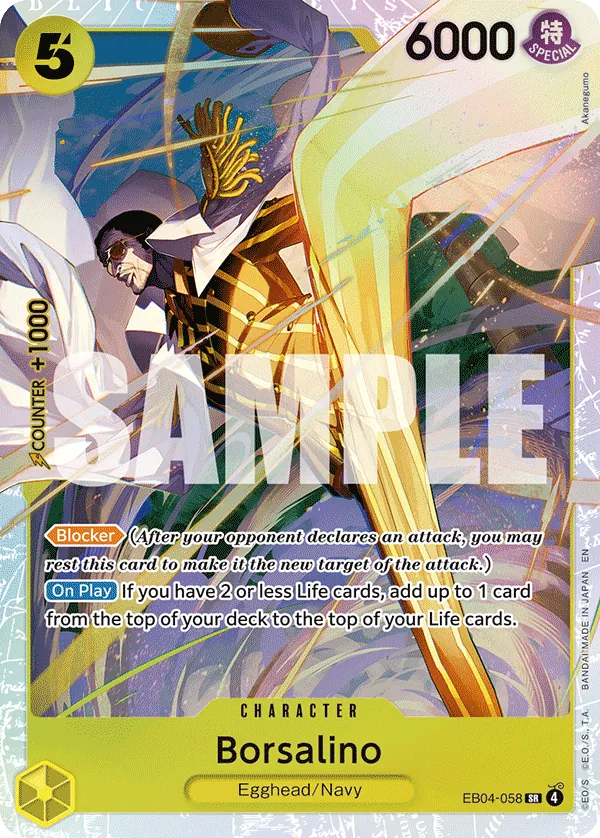
It’s important to frame that correctly, because the online narrative tends to get this wrong: One Piece has not overtaken Pokemon. It has consistently outsold one specific member of the traditional “Big Three” (Magic, Pokemon, Yu-Gi-Oh!) — specifically Yu-Gi-Oh! — for three straight quarters. That’s genuinely impressive for a game that only launched globally in 2022, but it’s a narrower claim than “One Piece is the #1 or #2 TCG in the world,” which it isn’t, at least not by this measure. Two One Piece sets, Adventure on Kami’s Island (OP-15) and The Time of Battle (OP-16), landed in the top five best-selling sets of the quarter, with Borsalino (OP-15) as the top-selling single at roughly $30.63 as of that report — notably a functional, playable card rather than a pure chase pull, which says something about how much of One Piece’s sales volume is driven by actual deckbuilders rather than speculators.
Zoom out to the manufacturer level and the picture gets more balanced. Bandai Namco’s own FY2025 integrated report states the company ranks third globally in trading card game market share (as of March 2025), behind the market leaders. Bandai’s card game business — which includes both One Piece Card Game and Dragon Ball Super Card Game — has been a major growth driver for the company’s Toys and Hobby unit, which posted record net sales for a seventh consecutive period, but Bandai as a company is still not the outright TCG market leader worldwide. One Piece’s marketplace strength in the US is real and worth taking seriously if you’re deciding where to invest time or money, but it’s one data point, not proof the game has “won.”
Gameplay Depth: DON!!, Energy, and Charge
This is where the three games diverge the most, and it’s the part most price comparisons skip.
One Piece Card Game uses five card types — Leader, Character, Event, Stage, and DON!! — and its signature resource system revolves around DON!! cards, which you manage as both a currency you attach to characters for combat power and an active resource you can hold back for tricks like Blockers or counters. You’re making a DON!! allocation decision nearly every turn, on top of tracking your opponent’s Life cards (which can be “triggered” for surprise effects when your Leader is attacked) and counter-play windows during combat. It’s genuinely one of the more mechanically dense TCGs on the market right now, and that complexity is a big part of why competitive players find it rewarding — but it’s also a real barrier. Community estimates (echoed by sites like Shonen TCG that track new-player onboarding) put One Piece at roughly 8–12 sessions before a new player feels comfortable making DON!! and block decisions on the fly, versus 4–6 for Dragon Ball.
Pokemon TCG layers Pokemon, Trainer, and Energy cards around a Prize-card win condition — you win by knocking out opponents’ Pokemon and claiming Prize cards, not by direct life-total damage. Energy attachment is usually capped at one per turn, and the deep strategic layer comes from Trainer/Supporter card sequencing and evolution lines rather than a single unified resource system. It’s approachable to learn but has enormous depth in deckbuilding, which is part of why it has stayed the most-played TCG globally for over two decades.
Dragon Ball Super Card Game: Fusion World is the leanest of the three by design: three card types (Leader, Battle, Extra) and a simple energy system where you charge one card face-down per turn to build resources. It borrows One Piece’s Leader/Life-card/Awakening skeleton (both games share some structural DNA — Fusion World launched in 2024, two years after One Piece), but strips out DON!!-style resource juggling. That makes it the fastest game at the table and the easiest to teach a friend in one sitting — but some longtime players find the reduced decision space means games can feel more “solved” once a deck’s core line is known, since there are fewer moving parts to disguise your plan.
The honest tradeoff: if you want a game where skill expression comes from managing a resource system turn after turn, One Piece rewards that. If you want a game that’s fast to teach and fast to play, Dragon Ball wins. Pokemon sits in the middle — easy first game, but a genuinely deep deckbuilding metagame once you’re a few months in.
Format Legality and Rotation: The Landscape Just Changed
This is a fact that a lot of comparison articles are still getting wrong because it’s brand new: One Piece Card Game introduced its first-ever set rotation on April 1, 2026. For its first four years, One Piece had zero rotation — every card from OP-01 onward was tournament-legal forever, which was a genuine selling point over Pokemon. That changed this year. Cards are now grouped into Blocks of four sets, and Standard Regulation allows the three most recent blocks — as of August 2026 that’s roughly OP-05 through OP-16, with Block 1 (OP-01 through OP-04) pushed into an unrestricted “Extra Regulation” format where every card except the shared banned/restricted list remains playable. If you’re buying older OP-01 through OP-04 product purely to build a Standard-legal competitive deck, be aware most of those Leaders are no longer tournament-legal outside Extra Regulation events.
Pokemon TCG has used regulation-mark rotation since 2011, and 2026 is no exception: the Standard format dropped cards with the “G” regulation mark this year (rotation took effect March 26, 2026 for Pokemon TCG Live and April 10, 2026 for in-person Play! Pokemon events), keeping H, I, and J marks legal. This is the most predictable rotation cadence of the three games — useful if you want to plan purchases around a known schedule, but it also means competitive Pokemon product has a shorter useful shelf life than it used to.
Dragon Ball Super Card Game: Fusion World has no rotation at all — every Fusion World set remains legal, and the format is managed purely through a Banned/Limited/Errata list that BANDAI updates periodically (five cards were banned and four limited as recently as July 2026, hitting decks built around Vegeta, Kefla, Nuova Shenron, Majin Buu, Zamasu, and Pan: Xeno Leaders). That’s the upside of a smaller, younger card pool: no rotation anxiety yet. The downside is the same one every non-rotating format eventually faces — as the card pool grows, older staples can quietly become “must-run” auto-includes that crowd out newer strategies until BANDAI steps in with a ban.
Cost to Get Competitive
This is where I’d push back hardest on the “One Piece is winning” narrative if you’re on a budget. Real prices fluctuate constantly and this isn’t financial advice — treat everything below as a snapshot as of August 2026, not a guarantee.
| Factor | One Piece Card Game | Pokemon TCG | Dragon Ball Super (Fusion World) |
|---|---|---|---|
| Starter/theme deck | ~$15–25 | ~$15–20 | ~$15–20 |
| JP booster box (retail) | ~13,000–31,000 JPY (~$90–210) | ~13,000–50,000 JPY (~$90–340) depending on set | ~9,900–12,200 JPY (~$65–85) |
| Rotation system | New (April 2026), blocks of 4 | Regulation marks since 2011, annual | None — banlist only |
| Competitive deck budget | ~$200–600 | ~$80–150 for most viable decks | ~$150–300 |
| Realistic chase-card ceiling | Manga Rare Gear 5 Luffy: $4,000–$7,700+ (English, ungraded, March 2026 pricing) | Japanese SAR (Charizard ex, Iono): ~$300–$850+ | SR/SCR promos: usually $10–$30, occasional $100+ outliers |
| Learning curve | Slowest (8–12 sessions to competency) | Moderate | Fastest (4–6 sessions) |
A few caveats that matter more than the raw numbers: Pokemon’s reputation as the “budget” TCG is well-earned at the deck-building level — a tournament-viable 60-card Standard list can genuinely be built for well under $100 in most metas — but that’s specifically about playable singles, not the chase alt-art SARs that drive Pokemon’s collector market, which can run into the hundreds of dollars each. One Piece’s competitive floor is higher mostly because Leaders and key Rares command real prices immediately on release, and its true chase cards (serial-numbered Manga Rares) are in an entirely different price universe than anything Pokemon or Dragon Ball currently produce. Dragon Ball is the cheapest game to be competitive in almost across the board, but that’s partly a reflection of a smaller player base and lower secondary-market liquidity — thinner buyer pools can mean it’s also harder to resell singles quickly if you ever want to cash out or switch archetypes.
Collector Market: Chase Cards and Long-Term Value
None of this is financial advice — card values move fast in both directions, and past performance of any TCG’s secondary market is not a guarantee of future results. With that said, here’s how the three compare as collectibles right now.
One Piece’s ceiling is the highest of the three by a wide margin. Serial-numbered and Comic Parallel versions of Gear 5 Luffy have traded well above ¥600,000 (roughly $4,000+) in Japan, with the English print reportedly listed even higher on some marketplaces — driven by One Piece’s massive global anime popularity and Bandai’s scarcity-focused parallel/SEC rarity structure. The risk here is obvious: those prices are largely driven by hype around a single, extremely popular character (Luffy) at the peak of the anime’s Egghead/post-timeskip arcs, and Manga Rare pricing has historically been volatile when a card’s competitive relevance shifts or a new, flashier alternate art releases.

Pokemon’s collector market is broader and arguably more stable — its Special Art Rare (SAR) tier spans a wide range from roughly $50 for lower-demand Pokemon up to $800+ for flagship chase cards, and that market has decades of trading history behind it, which tends to smooth out volatility compared to a newer game. The tradeoff is that outside of a handful of iconic characters (Charizard being the obvious one), most Pokemon singles don’t appreciate dramatically — it’s a more “index fund” style collector market than a lottery-ticket one.
Dragon Ball Fusion World’s collector market is the smallest and least mature of the three. Most SR-tier singles sit in the $10–$30 range, which is great for players who just want a playable deck, but it also means the game currently lacks a Manga Rare Luffy or SAR Charizard-tier flagship chase card that draws in pure collectors and speculators the way One Piece and Pokemon do. That could change — the original Dragon Ball Super Card Game (pre-Fusion World) was historically one of Bandai’s best-selling franchises, per sales data cited by outlets like sabatcg.com — but as of mid-2026, Fusion World specifically hasn’t built that same collector premium yet.
Which Game Fits Which Kind of Player
- The competitive grinder who wants deep decision trees: One Piece Card Game. The DON!! system and combat-trick windows reward the kind of player who enjoys Magic-style sequencing puzzles, and the tournament infrastructure (Regionals, Treasure Cups with 1,000+ player fields, a World Championship) is the most developed of the three outside Pokemon.
- The budget-conscious player who wants to play competitively without a big buy-in: Pokemon TCG. A viable Standard deck is realistically achievable for well under $150, and the rotation schedule is predictable enough to plan around.
- The new player or parent looking for the easiest game to teach: Dragon Ball Super Card Game: Fusion World. Fewer card types, a simpler resource system, and cheap booster boxes make it the lowest-friction entry point of the three, especially if the household is already Dragon Ball fans.
- The collector chasing long-term chase-card value: One Piece, if you can stomach real volatility and higher buy-in prices, or Pokemon if you’d rather have a broader, more established secondary market with lower single-card ceilings but more liquidity.
Frequently Asked Questions
Is One Piece Card Game really outselling Pokemon?
No — this is a common misreading of the data. Per TCGplayer’s Q2 2026 GMV report, Pokemon ranked #2 among all trading card games sold on TCGplayer, ahead of One Piece at #3. What One Piece has done is consistently outsell Yu-Gi-Oh! (#4) for three consecutive quarters, which is a meaningful milestone but not the same as beating Pokemon.
Which of the three is cheapest to play competitively?
Pokemon TCG has historically had the lowest average cost for a tournament-viable deck, with many competitive lists buildable for under $150 as of 2026. Dragon Ball Super Card Game: Fusion World is close behind at roughly $150–300 per competitive deck. One Piece Card Game tends to run higher, typically $200–600, because Leaders and key Rares carry real value from the moment a set releases.
Does One Piece Card Game have deck rotation now?
Yes. As of April 1, 2026, One Piece introduced its first-ever Standard rotation system, organizing sets into Blocks of four with the three most recent blocks (roughly OP-05 through OP-16 as of August 2026) legal in Standard play. Older cards remain usable in an unrestricted “Extra Regulation” format, minus the shared banned/restricted list.
Where can I safely buy real Japanese booster boxes for any of these games?
Stick to established importers or affiliate marketplaces that list verifiable stock, like Discovery Japan Mall, rather than unusually cheap loose singles from unverified marketplace sellers — counterfeit and altered cards are a real risk in this category, especially for high-value chase cards like Manga Rares or SARs. If a deal on a “graded” or serial-numbered card looks too good to be true relative to recent sold listings, it usually is.
Which game has the steepest learning curve for a total beginner?
One Piece Card Game, mainly due to DON!! resource management and combat-trick timing — most new players need roughly 8–12 games before it clicks. Dragon Ball Super Card Game: Fusion World is the fastest to learn at 4–6 games, with Pokemon TCG in between.
The Takeaway
There’s no single “best” answer here, and any article that tells you otherwise is selling something. One Piece Card Game earns its current market strength honestly — TCGplayer’s Q2 2026 data backs up three straight quarters of outselling Yu-Gi-Oh!, and its DON!! system genuinely rewards deep strategic play — but it’s also the priciest of the three to compete in and just adopted its first rotation system, so the format is in more flux than it’s been in years. Pokemon remains the most accessible on cost and the most established as a collectible, but its ceiling for explosive single-card value is generally lower than One Piece’s top Manga Rares. Dragon Ball Super Card Game: Fusion World is the easiest on your wallet and your learning curve, at the cost of a thinner competitive scene and a collector market that hasn’t matured yet. If you’re deciding where to put your first $100 this month, buy based on which universe you’d rather spend a hundred hours in — the mechanics differences are real enough that it should matter more than which game topped a quarterly sales chart.
If you’re brand new to One Piece specifically and want the full rules rundown before buying anything, check out our beginner’s guide to One Piece Card Game, and if you already play and want to know which Leaders are actually winning right now, see our OP-16 Leader tier list.
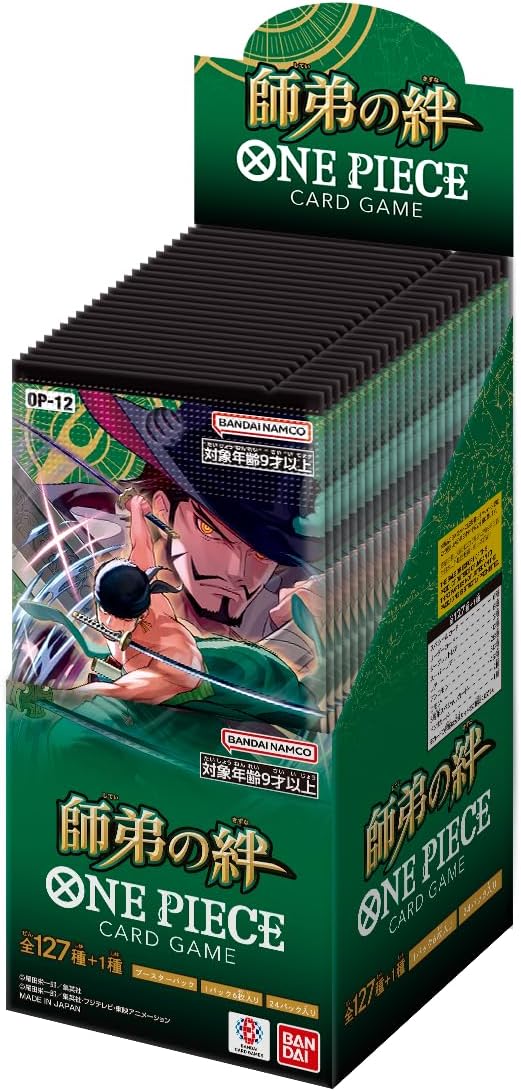
For real Japanese product across all three games, Discovery Japan Mall currently stocks the BANDAI ONE PIECE Card Game Bond Between Master and Disciple (OP-12) Booster Box and the crossover-heavy BANDAI ONE PIECE Card Game Extra Booster Anime 25th Collection (EB-02) Booster Box for One Piece — note EB-02 is a reprint-driven Extra Booster, so it’s a fun set to open but not the place to look for the newest competitive tech. On the Pokemon side there’s the Pokemon Card Game Scarlet & Violet Glory of the Rocket Team Booster Box — worth knowing that older Scarlet & Violet-block product is getting closer to rotating out of Standard as newer regulation marks roll in, so buy it for collecting or casual play rather than assuming long-term tournament legality. And for Dragon Ball, there’s the BANDAI Dragon Ball Super Card Game Fusion World Unknown Adventure (FB-05) Booster Box, a solid low-cost way to try the simplest of the three games before committing further.


Related Articles
More Trading Card Game Guides
- Dragon Ball Fusion World vs Pokémon vs One Piece TCG: The Real Comparison (Dragon Ball Super Card Game)
- Pokémon TCG Beginner’s Guide 2026: What to Buy First (Pokémon TCG)
- Naruto Card Game Leader Cards: Who’s Likely to Get One? (Naruto Card Game)
Comments